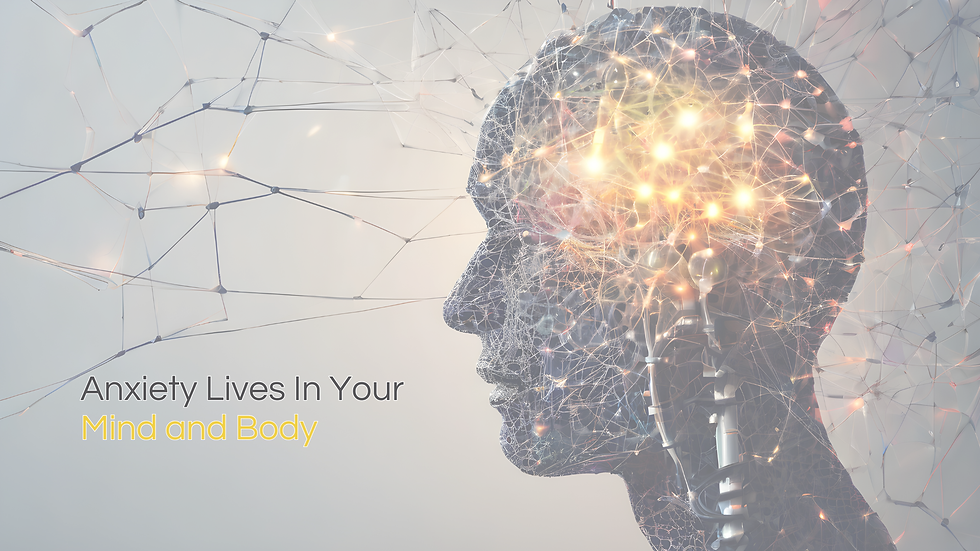
Anxiety Lives in Your Mind and Body
You can feel it before you even think it. The tightness in your chest. The shallow breath.
The sudden wave of unease that seems to come out of nowhere.
Then your mind kicks in.
“Why am I feeling like this?”
“What’s wrong?”
“What did I do?”
You start scanning your thoughts, trying to find the cause. Trying to fix it. Trying to calm yourself down.
Sometimes it works. Most of the time, it doesn’t last and there’s a reason for this. It is because anxiety is happening in your body first.
The part most people miss
If you’ve been dealing with anxiety for a while, you’ve probably been told some version of “Change your thoughts.”
And there’s truth in that. Your thoughts do influence how you feel. They precede every one of your emotional states and reactions. This is where many people get stuck.
When your body is already activated, your conscious thoughts are no longer in control. Your mind is reacting.
A client earlier this week said to me that she woke up anxious before she even have a minute to form a coherent thought.
That’s not a mindset issue. That’s a nervous system response. The body has learned a pattern somewhere along the way and now it is deploying the response automatically. If you were to ask your mind why, it would simply tell you it is being efficient. And it is, that’s its job.
Why thinking your way out doesn’t work
Your brain and your body are constantly communicating. But they don’t operate at the same speed. Your body is faster. It’s designed that way. It detects signals, assesses safety, and responds, often before your conscious mind has time to interpret what’s happening.
So when your system perceives stress (even subtle stress), your body shifts into a state of activation where you may experience heart rate increases, breathing changes, the tightening of muscles.
This is where you mind tries to make sense of it. It looks for a reason for these changes and if it can’t find one, it creates one. This is partly why anxiety can feel so confusing.
You’re trying to solve a physical and emotional experience with a mental strategy. And it leaves you feeling like you’re chasing something you can’t quite catch.
It’s not just mental. It’s layered. To understand anxiety more clearly, you have to zoom out. Your experience is happening across multiple layers at the same time.
Your body.
Your emotions.
Your thoughts.
Your overall state.
They’re all interacting and that means that if one is off, the others follow. Here is an example many of us can relate to. You don’t sleep well for a few nights so eventually your body becomes more sensitive. This leads to your stress threshold dropping.
You drink more caffeine to compensate for the lack of sleep so your system becomes more stimulated and your baseline tension increases.
Now a small stressor shows up: a less than pleasant conversation, a rushed decision, an unexpected bill and…
Your body reacts strongly.Your emotions spike while your mind jumps in to interpret what’s wrong. And now you’re in a full anxiety loop. Nothing about that started in your conscious thoughts.
Your thoughts amplified what was already happening in your nervous system. When your system is overloaded, everything feels like a threat.
Another pattern that shows up often is when people say they feel anxious “for no reason.” But when you look closer, there are always inputs.
Chronic stress.
Constant stimulation.
Unprocessed emotions.
Physical depletion.
Anxiety and stress build quietly over time until your system reaches a threshold. At that point, your body becomes hyper-aware. Everything feels louder and more urgent. You start to feel like you are on edge all the time and if just one more person asks you a question, touches you, makes a demand, your cup is going to overflow.
That’s a sign of an overloaded system trying to protect itself.
The shift: stop treating anxiety like a thought problem
When you understand that anxiety lives in more than just your mind, your approach changes. You stop trying to control every thought and instead start working with your system. This is where real change begins. By creating the conditions where calm becomes natural.
here is what actually helps (and why it works). Start with the obvious, but often ignored, factors.
Sleep: When your sleep is inconsistent or insufficient, your nervous system becomes more reactive. Your body has less capacity to regulate stress. What you might normally handle with ease starts to feel overwhelming.
Caffeine: It’s one of the most overlooked contributors to anxiety. It stimulates your system, increases heart rate, and mimics the physical sensations of anxiety. If your baseline is already elevated, caffeine pushes it higher.
Stress accumulation: I’m not talking about just big stress. I mean the small, constant stress that we get from scrolling, notifications, multitasking, lack of downtime. Have you heard the term “death by a thousand paper cuts”? Think of stress accumulation as “anxiety by a thousand triggers”.
When you’re living like this day in and day out, your system never fully resets. So it stays activated and over time, that becomes your “normal.”
Then there’s the emotional layer.
Unprocessed experiences don’t disappear. They stay in the system. And they show up as tension, reactivity, or a constant underlying sense of unease. If you don’t create space to process them, they keep feeding the cycle.
Rewiring this process happens through experience and repetition. This is where a different approach matters. if you don’t teach your system a new way to respond it has no choice but to default to old patterns.
This is the foundation of rewiring your brain. You create new patterns by experiencing regulation in real time.
Over time, your baseline shifts and your body becomes less reactive. Yes, over time. I know that you want there to be a magic button. Unfortunately, you didn’t learn anxiety and reactivity in one shot, it took time. The opposite is also true. The good news is that when you decide it’s time, your brain and body move quickly to new patterns.
A different relationship with anxiety
When this work starts to integrate, something subtle changes. Although anxiety doesn’t disappear overnight, it does begin to feel different very quickly. You might still notice the sensations in your body to start but you will find that you are not immediately pulled into it.
You have space to notice and space to move in a different direction. These moments begin to feel like magic: you feel like you’re almost suspended in time and you can witness yourself choosing and feeling differently.
This is encouraging which leads to even more change as you understand that something deeper is happening. And you get to watch it in real time.
If you’re at a place where your anxiety hasn’t shifted yet, it doesn’t mean it can’t. It may mean that you haven’t been working with the full picture.
If you want to understand where your anxiety is actually coming from, and how to start shifting it, you need to see how these layers are interacting in your system.
Download any Understanding Yourself Guidebook for free and see what you learn about you and your bodies.
It will give you a clear starting point.
From there, you can begin to work with anxiety in a way that actually creates change.